
The South Halsted Corridor Plan Market Study is now live! Read on for high-level insights from the Project Team’s analysis.
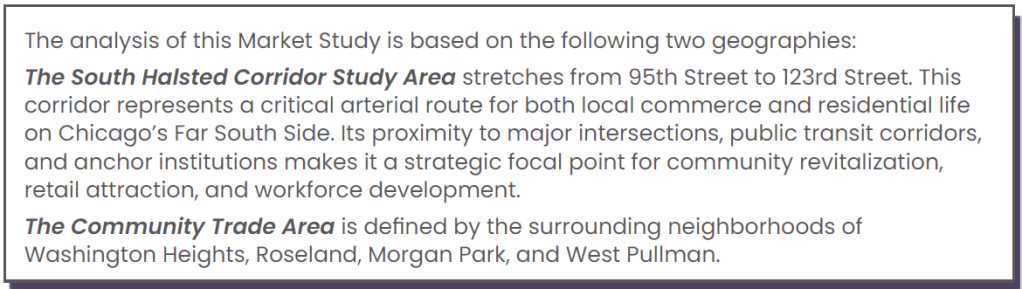
Community Demographics
- The Corridor houses approximately 14,660 residents within a larger 106,000-person Community Trade Area. The community is predominantly Black (94.8% Corridor)
- Slightly older median age (45.3 vs. 42.3), indicates needs for health services, aging-in-place, and senior amenities.
- 40.8% of Corridor residents hold a post-secondary degree (vs. 37.6% Trade Area), suggesting readiness for job training, healthcare, and professional services growth.
- Median household income is $62,384 (above Trade Area’s $57,246 and close to citywide), and owner-occupancy is strong (63.2% vs. 54.3%), indicating a stable homeowner base that can anchor infill and rehab.
Owner-occupancy along the Corridor is strong, with 63.2% of homes being owner-occupied.
Housing
- One in two renters is cost-burdened, versus one in five owners.
- Among households under 65 earning ≥80% AMI, estimated capture is 233-364 market-rate units (4–5% penetration).
- Significant need at ≤60% AMI yields 393–526 affordable units (4–5% penetration).
- With more than one in five residents over age 65, senior housing demand is the largest cohort: 608–760 units across AMI levels, not currently met in the pipeline.
- Three active projects (Morgan Park Commons, Jackie Robinson Village, The Rise) add 422 units total (134 affordable; 288 market/mixed). These meet ~13–16% of affordable need and 0% of senior need. Family-sized units (≈118+) are a bright spot.
More renters along the Corridor are burdened by housing costs than owners. There is significant need for affordable units in the Corridor area.
Retail
- Far South retail vacancy is 23.2% (Q2 2025) with negative quarterly absorption (-26k SF), pointing to a soft leasing environment in older stock even as anchors near the Corridor perform better.
- Corridor spending is projected to rise 10.5% from $150.0M to $165.8M (2025–2030). Trade Area growth exceeds $98.5M, translating to demand-based supply of 26k–40k SF from 2026–2030. (5% capture rate at $375/SF).
- Moody’s CRE projects 145k SF of retail to transact in the Corridor (2026–2030), favoring reinvestment and repositioning over large new builds.
- South Chicago Submarket fundamentals remain resilient (rents trending toward ~$7/SF; low-to-moderate vacancy after 2021 surge). Historic transactions indicate 2.7M SF average of activity with a potential of almost 680M SF of transactional potential in the Corridor (2026-2030). Proposed new supplies could land near the submarket, with an aging stock and underutilized parcels creating a modernization opportunity.
Corridor spending is projected to rise 10.5% in the next five years, translating to additional retail square footage demand.
Transportation & Tourism
- Metra access (West Pullman Station), major arterials (I-57/I-94), planned Pace Pulse service, and proximity to Pullman National Historic Park and the Obama Presidential Center position the Corridor to leverage tourism/visitor experiences, especially if paired with a marquee cultural/food hub and Major Taylor Trail placemaking.
The Corridor’s location and transit access makes it advantageous for potential investments in tourism and visitor experiences.
Surprised by any of the findings? Have an idea to share? Head to our Virtual Open House Poll and weigh in on the types of retail, housing, and transportation improvements you’d like to see along the Corridor!
 South Halsted Corridor Plan
Leave a comment